- Published on
Microduck: spatial mapping
- Authors

- Name
- Mohamed Abdelrahman
I want embodied systems that perceive, remember, and reason about the places they move through, with state you can inspect instead of a black box. To stress-test that in practice, I need a body that walks, looks around, and keeps going when the world is messy.
That body, for now, is Microduck from Pollen Robotics: a small two-legged robot, about 25 cm tall. It walks using policies trained in simulation (the same files you can run on the real duck or download from Hugging Face). I run those policies in a furnished apartment in sim and ask a simple question: can it build a useful map while it moves?
# A walking robot, not a sliding dot
Microduck uses its legs, neck, and head for real balance, not a point that slides on the floor. Pollen’s onboard software runs a walk policy many times per second over the whole body. You send simple commands (move, look); the policy turns them into steps. I keep that policy and add mapping on top. The camera sits on the head, so the map comes from what the duck sees while it walks.
# Why a whole flat in simulation
One empty room is easy. A home is not. Doors, tables, chairs, and long paths mean the camera loses a place and sees it again from another angle. I send the duck on a long indoor route (roughly 160 meters and about a hundred stops) so the map has to handle real clutter.
# What happens on a run
Two things run at once today. They do not talk to each other yet, but both matter.
The map grows while it walks. The head camera sends color video, distance to objects, and where the camera is in the room. Software turns that into a 3D map of walls and furniture, plus labels for rooms and objects you can click through, not just a blob of points. I watch it update live in Rerun.
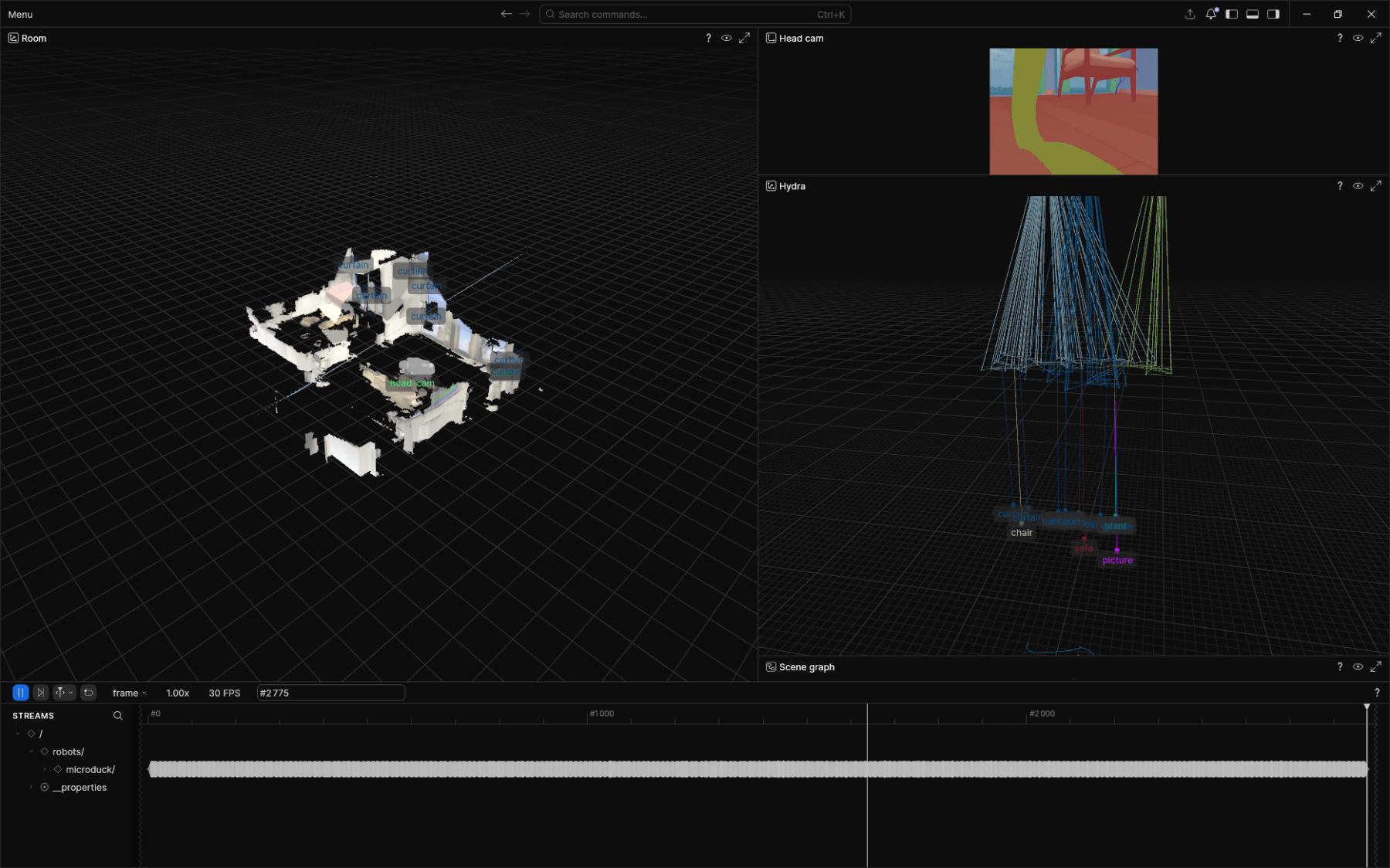
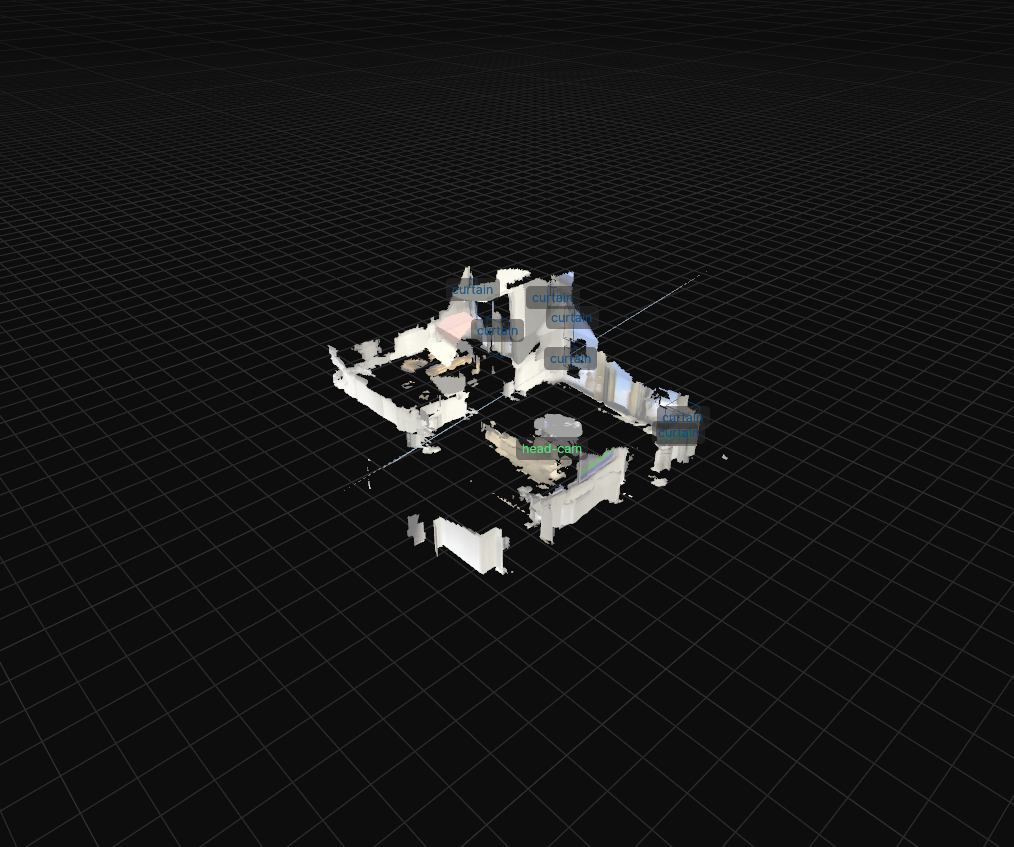

The route is fixed in advance. The duck follows a path planned before the run, room to room. If it jams on furniture, I skip it forward on the route so the session keeps going. That keeps demos alive. It is not the duck reading its own map and picking a new way around a table. Hooking “what I mapped” to “where I go next” is the next step.
# When the duck gets stuck
Furniture and doorways are tight for a robot this size. In sim it ends up under tables and against chair legs, still trying to follow the route.
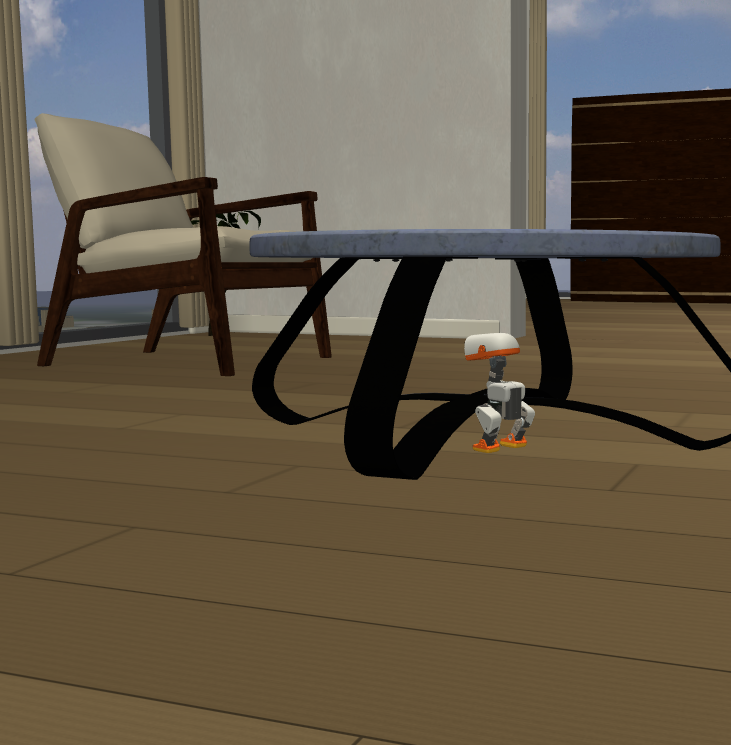
Skipping ahead on the path is a blunt fix. Next step: use the camera distance or the map already building to step around obstacles instead of pushing into them. That is when mapping and motion need to work as one loop.
# Where this is headed
The goal is inspectable spatial state on a real walking platform: Pollen’s public walk policies, mapping in sim first, then the same policy files on hardware when ready.
If spatial mapping on a walking robot is your problem too, say hello via the about page.